Climate change is progressing and destroying planet earth. One day, nature had enough and decided to get rid of this pest called humanity. More and more nature disasters take place and decimate the human population. As many cities are not habitable anymore the people are running out of living space.
You probably thought you will be helping the humans, but you are wrong! You play as nature and your goal is to get rid of every last human being. To do this you have a large tool set of nature disasters at your disposal. Will you send a meteor, a tsunami or even a bear?
How to play
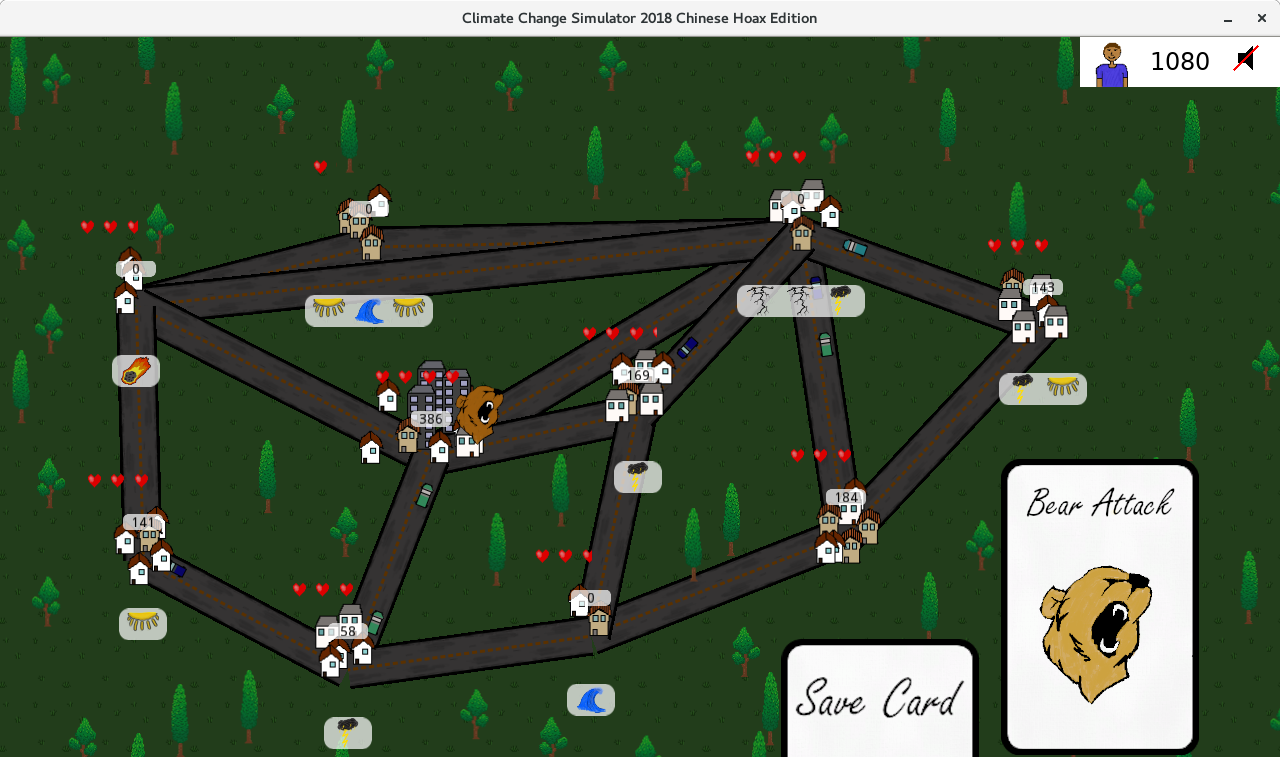
In each turn you draw a card from the pile. You then have to perform the action displayed on the card. Most of the cards are disaster cards. With these you can choose a city, or for some also a road, where the disaster will take place. There is also a city and a road card. The first will establish a new city and grant humanity some more space to hide from you. Although you can not prevent the creation of the city you can choose where it is built. After drawing the road card you have to build a new road between two cities. To do this, click on the first city and then on the second city. After the action was performed you may draw a new card.
If you don't want to play a card right away you may save at most one. To do this you can click on the card to the left. You can not do this if there is already a card there. To use it later you click the card *before* you draw a card from the pile.
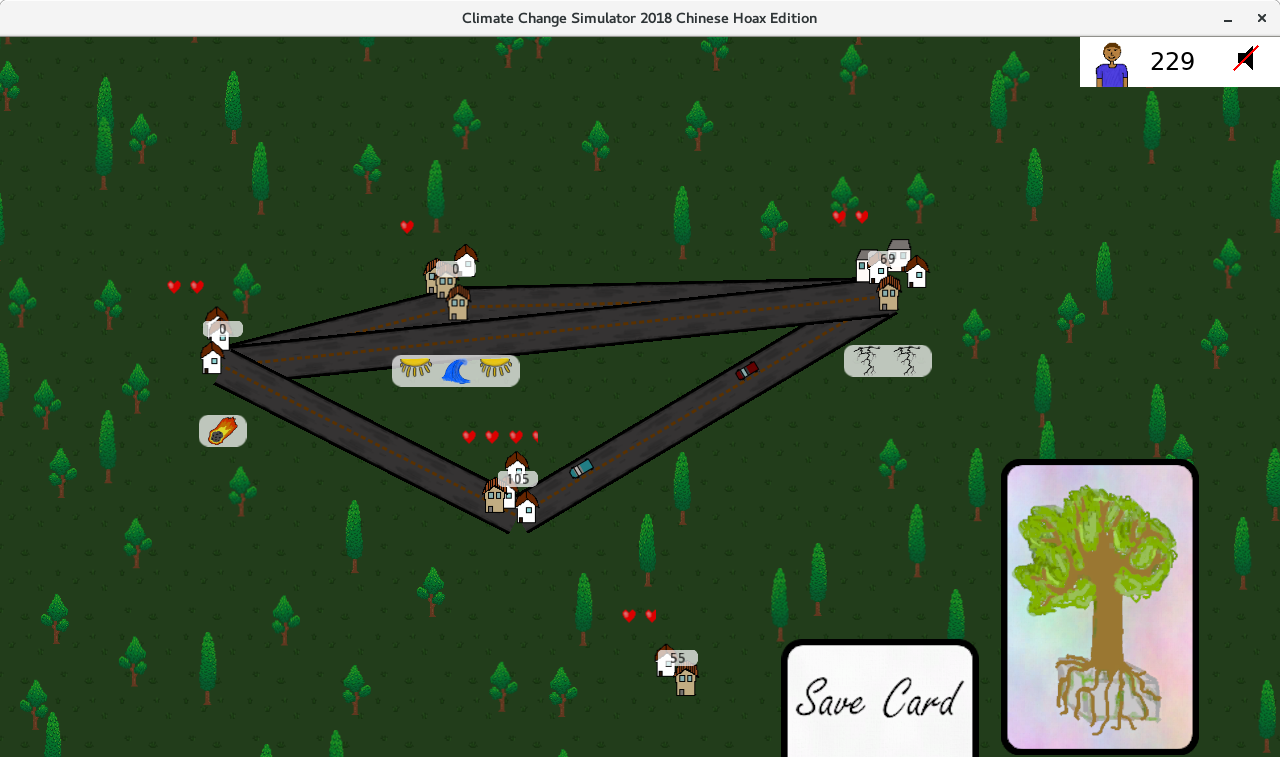
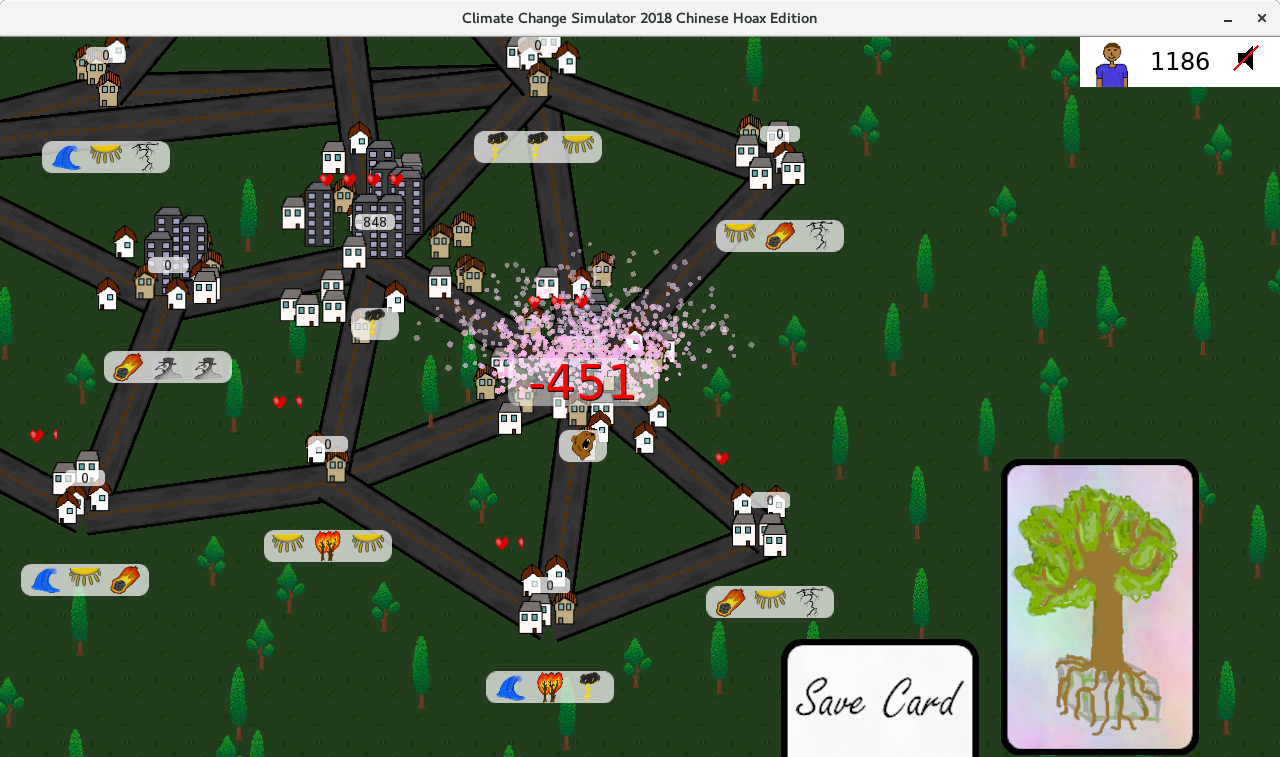
Each city has an associated attractiveness which is influenced by many factors including population, number of connected roads, age and occurred disasters. People will move from cities with low attractiveness to directly connected cities with high attractiveness. The rate at which they move depends on the difference in attractiveness. The attractiveness is displayed with the hearts above the city. The number below the hearts is the population of the city.
A nature disaster will lower a cities attractiveness and thereby might drive people to neighboring cities. It will also kill part of the population. Some disasters kill a certain percentage of the population while others kill a fixed number, or a combination of both. A few disasters can be applied to roads and will destroy the road. The following table shows the effects of the different disasters.
Disaster
Relative
Absolute
Attractiveness
Road?
Heat Wave
5%
20 - 30
0.1
No
Thunderstorm
5%
-
0.2
No
Earthquake
10%
-
0.8
Yes
Forest Fire
40%
-
0.8
No
Bear Attack
50%
50 - 200
1.2
No
Plague
70%
-
1.7
No
Meteor
-
50 - 100
2.0
Yes
Tsunami
-
20 - 30
2.0
Yes
If the same disaster happens several times in the same city it will boost the effects of the disaster. For this only the last three disasters are taken into account. They are displayed under each city.
You win as soon as the global population reaches zero.
Controls
You can play the game without a keyboard. For some actions there are keyboard shortcuts:
- Move map: W/A/S/D or Arrow Keys - Next card: Space or Enter - Save card: Q
If you wish to turn off the music you can click the button in the top right corner.
Credits
Design, Code, Audio by Matteo Signer and Benjamin Schmid. Art by Patricia Schmid. Created in Godot.
HTML5 does probably not work correctly, your browser needs to support both WebAssembly and WebGL 2.0
You need to replace "If you wish to turn off the music you can click the button in the top right corner." by "If you wish for the humans to stop annoying you with their music, kill them."
I can't actually run the browser version ( I have windows and use chrome ). I tried the win version, I like the game idea but I think some small stuff could have been polished... but overall really catchy and fun game!
Good game! When I was about to kill the population it came 5 city-cards after each other. One QOL update would be to disable the movement of the screen with the mouse, or add the ability to disable it.
Haha what a good idea. The music was nice and we had a lot of fun trying out the cards. The mechanics are well worked-out. The graphics are also very cute. those trees!! Very cute :) A suggestion for the future would be to add some animations for the catastrophes. Well done! :smiley:
Imagine disasters in Sim City and turn them into the Cards Against Humanity flash game - then this game would be it. It is so addicting that I had a great time.
You guys tortured me so much trying to beat this game! Everytime I got a lucky streak of bear attacks I had to put in like 2 cities as punishment. This game is fun and stomping out the numbers is really satisfying. The cards feel a bit skinner box-ish as I kept playing trying to see if I could get a good run and finish the game but I actually never did despite putting in a good amount of time. Gratz on making such a deep game in this time. I really liked the change of pace, this game is pretty unique compared to others in this jam and an excellent take on the theme. Perhaps I'll revisit this near the end of voting when I have more time and finally knock it out~
Neat game! I included it in my compilation video series of the Ludum Dare 42 compilation video series, if you’d like to take a look. :) https://youtu.be/8T98Y6n8oZk
Wow! My kind of environmental game! I thinks this also as a great table top multiplayer game where one plays as the nature and others play as humans ... perhaps with some adaptions. Really good idea!
As I am going through many of these games I really enjoyed this one. I felt the card turning animation could be faster so as to keep the pace of the game up and the city card was not all that obvious (in that you had to place it further away) but it was cool to try and figure out the best place to put each card. And its always nice to see a Godot game.
@honey Thanks. I know about this issue, I have the same problem on my computer. But there isn't really much I can do, it's just a problem with the export from the engine. For now you will have to download the desktop version if you want to try it.
Lovely game, building up the world had a sort of Carcassonne feeling to it and I especially liked how the population dynamically reacted. Bear attacks ftw!
0 - Main Mechanics: The mechanics of taking cards at random and using them as a weapon in a choice reflected from where to use ... Very interesting your idea. It was well implemented in this regard.
1 - Secondary Mechanics: There is a card that forces the player to enlarge the human contingents (new cities) and another that forces to create new roads. I found these mechanics equally interesting and well implemented.
2 - Learning Curve: The game has simple control, so learning how to use the cards is quick (at least for me). And the cards are explained by themselves.
3 - Flow: The challenge of the game grows if the person goes bad at first, with bad choices or even by chance. For the game to become more challenging to the "good" (experienced, lucky, I do not know); I believe that the ideal would be to implement ways of hindering (more letters that complicate, or events triggered by time or by low population number).
4 - Love Points: The mechanics of the game itself were very good (very interesting, fun and well implemented).
5 - Presentation of the Narrative: The narrative presented was simple, the game seems to be able to be embedded to other narratives (perhaps some of them can be more in depth). Since the focus is not the narrative (except for the humorous (or critical, I do not know) effect), then there is not much to evaluate in this matter.
6 - Art Polishment: The art can be polished, for more elaborate frames for the letters (etc). In Ludum Dare's time the art was very good.
7 - Monetization Attractiveness: I think this game could be monetized if it was released for smartphones (with advertisements). For this there should be several challenges (hence I do not know if it would totally combine with the current narrative, whether it would have to be presented gradually or not etc).
8 - Community Generation: A Facebook page (invite me to follow if I create) could help to generate a community of game players.
9 - Cultural Dialogue: Humanity is often accused of doing harm to the environment, I believe that from there arises the criticism made through the game (indirectly or directly). The game may (intentionally or not) reflect a little on the relationship man and nature (although it does not seem to be the focus). For the game to have a stronger character in terms of game-culture and culture-game, I believe that the narrative would have to be better worked on.
Nice game, Love how everything is balanced! Good luck, Don't forget to take a look at ours if you don't mind and see what it's like when we just focused on graphics in this game jam! Game Link: https://ldjam.com/events/ludum-dare/42/spacelab-42a
Nice. Textures could be a bit more polished. The mechanics are very well implemented and the sounds and particle effects are nice. The game is fun, but does not really have much replay value. The fact that the humans flee from cities is also really cool, this makes me feel like I'm trying to stop some sort of virus.
Interesting simulation. The interactivity is less so.
Destroying all the cities (and people) is very easy. Start from one corner, force the population to move to the other corner (build cities there too), and then take them out with the bears and plagues (what a combo!). There aren't any decisions to make after figuring out that optimal strategy.
In this case the more traditional take, working with the humans, would facilitate decision making better. Try to build the most effective city network, with limited space (and time/turns?), while having to choose which cities are affected by which random calamities. Touch choices, especially if the disasters had long lasting effects. They could also affect the connected cities, or roam around the place (the bears!)
The visuals are basic, but functional. The music does go off the scale at times, but otherwise sounds ok.


Comments33
You need to replace "If you wish to turn off the music you can click the button in the top right corner." by "If you wish for the humans to stop annoying you with their music, kill them."
I tried the win version, I like the game idea but I think some small stuff could have been polished... but overall really catchy and fun game!
Win 10, Chrome
I think my tactic was not good haha, or I undertood it too late xD
Do you plan on develope it more?
I just really wish that the card descriptions were in-game.
0 - Main Mechanics:
The mechanics of taking cards at random and using them as a weapon in a choice reflected from where to use ... Very interesting your idea. It was well implemented in this regard.
1 - Secondary Mechanics:
There is a card that forces the player to enlarge the human contingents (new cities) and another that forces to create new roads. I found these mechanics equally interesting and well implemented.
2 - Learning Curve:
The game has simple control, so learning how to use the cards is quick (at least for me). And the cards are explained by themselves.
3 - Flow:
The challenge of the game grows if the person goes bad at first, with bad choices or even by chance. For the game to become more challenging to the "good" (experienced, lucky, I do not know); I believe that the ideal would be to implement ways of hindering (more letters that complicate, or events triggered by time or by low population number).
4 - Love Points:
The mechanics of the game itself were very good (very interesting, fun and well implemented).
5 - Presentation of the Narrative:
The narrative presented was simple, the game seems to be able to be embedded to other narratives (perhaps some of them can be more in depth). Since the focus is not the narrative (except for the humorous (or critical, I do not know) effect), then there is not much to evaluate in this matter.
6 - Art Polishment:
The art can be polished, for more elaborate frames for the letters (etc). In Ludum Dare's time the art was very good.
7 - Monetization Attractiveness:
I think this game could be monetized if it was released for smartphones (with advertisements). For this there should be several challenges (hence I do not know if it would totally combine with the current narrative, whether it would have to be presented gradually or not etc).
8 - Community Generation:
A Facebook page (invite me to follow if I create) could help to generate a community of game players.
9 - Cultural Dialogue:
Humanity is often accused of doing harm to the environment, I believe that from there arises the criticism made through the game (indirectly or directly). The game may (intentionally or not) reflect a little on the relationship man and nature (although it does not seem to be the focus). For the game to have a stronger character in terms of game-culture and culture-game, I believe that the narrative would have to be better worked on.
Please do check my game maybe you’ll like it and leave some feedback.
Good luck, Don't forget to take a look at ours if you don't mind and see what it's like when we just focused on graphics in this game jam!
Game Link: https://ldjam.com/events/ludum-dare/42/spacelab-42a
Web version of the game was sadly not working.
Destroying all the cities (and people) is very easy. Start from one corner, force the population to move to the other corner (build cities there too), and then take them out with the bears and plagues (what a combo!). There aren't any decisions to make after figuring out that optimal strategy.
In this case the more traditional take, working with the humans, would facilitate decision making better. Try to build the most effective city network, with limited space (and time/turns?), while having to choose which cities are affected by which random calamities. Touch choices, especially if the disasters had long lasting effects. They could also affect the connected cities, or roam around the place (the bears!)
The visuals are basic, but functional. The music does go off the scale at times, but otherwise sounds ok.
Solid effort, no bugs. The design is lacking.