
Game of Life
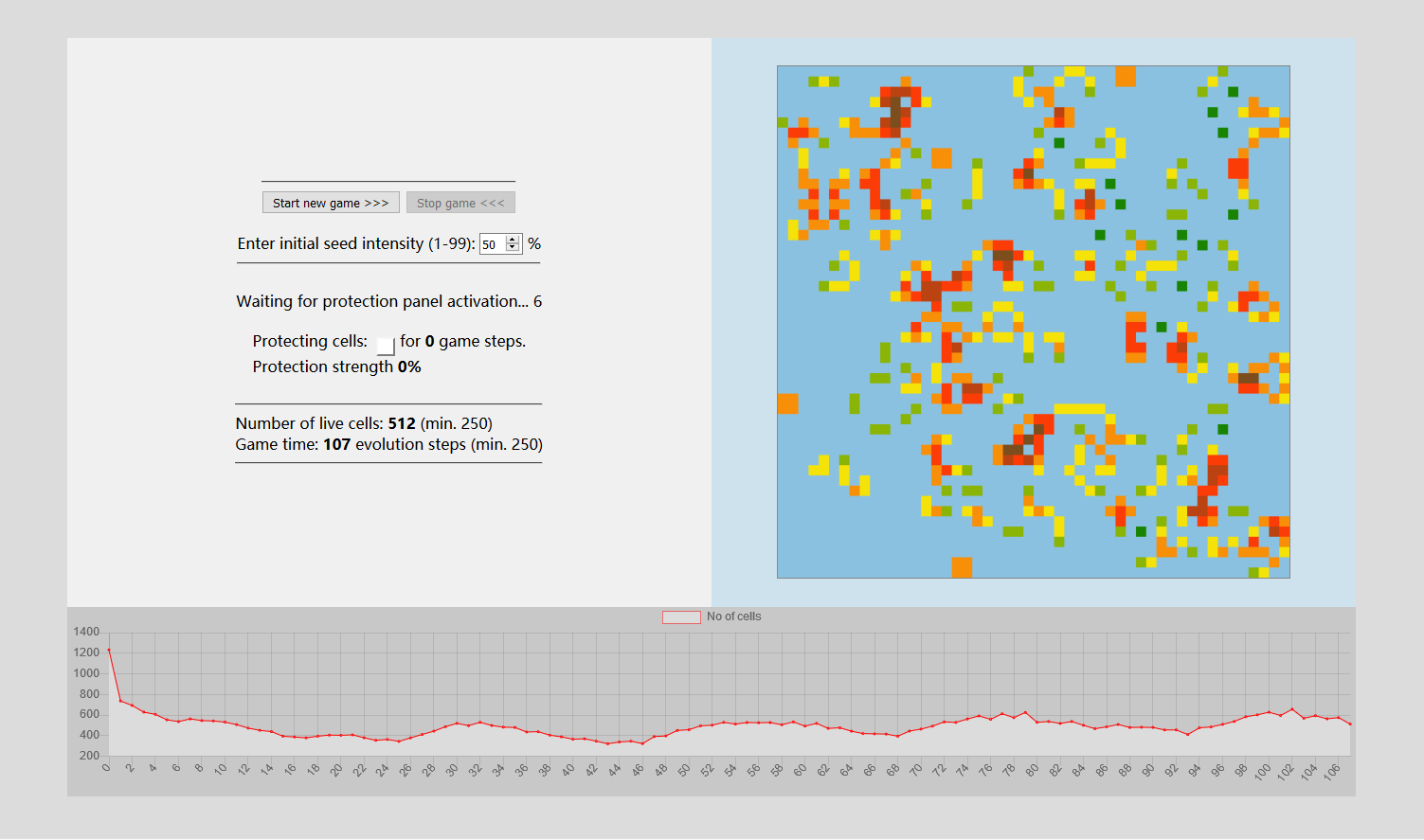
Game of Life is a so called * *'cellular automaton'* *, in which evolution takes place on a two-dimensional orthogonal grid of square cells. Each square can either contain an alive cell or be empty (dead cell).
At the beginning the board (in this instance measuring 50x50 squares = 2500 cells) is randomly populated. The 'seed intensity' parameter defines percentage of alive cells in relation to all possible cells on the board. Default value of 50% means that approximately (there is a probability factor involved) half (that is 1250) cells is alive at the start.
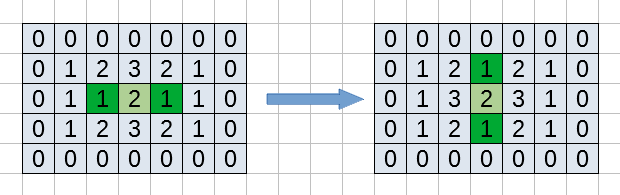
Cellular automaton evolves in steps. Current state directly determines state of a following step. Standard (Conway's) rules of Game of Life describe multiplications and deaths of cells:
1. For a square that is * *'alive'* *:
- Each cell with one or no neighbors dies,
- Each cell with four or more neighbors dies,
- Each cell with two or three neighbors survives.
2. For a square that is * *'empty'* * or * *'dead' * *
- Each cell with three neighbors becomes alive.
An example of an evolution step:
In this instance, cells are color-coded according to amount of neighbouring cells.
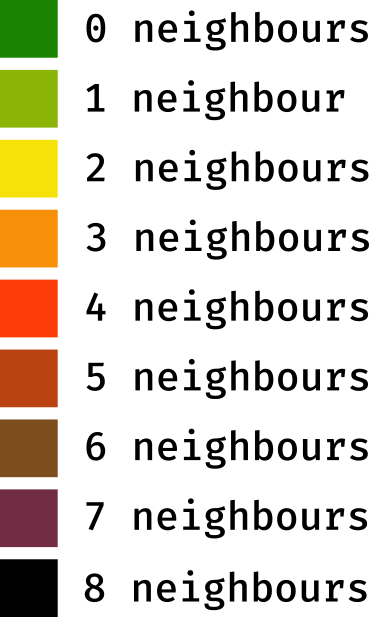
During the course of the game, cells of a chosen colour can be temporarily protected from dying. Not every colour is worth protecting, which results from the Game of Life's rules.
Protection from dying lasts for 12 evolution steps and is not 100% effective. Its strength decreases with each evolution step until reaches 0%. Protection can be turned on for the first time after 20 steps pass (and the color selection panel appears). Turning consecutive protection on is possible after 8 evolution steps.
The aim of the game is to survive at least 250 evolution steps with at least 250 alive cells (10% of the board)
Comments10
Mike Burns21 Apr 2020, 01:44
Cool twist!
NateTheGreat21 Apr 2020, 01:47
Fun twist on the game of life! Although for me the strategy ended up being pretty simple in the end, sometimes you just get unlucky from the start.

FireSlash12 May 2020, 05:15
I was just looking into the game of life earlier today; talk about coincidences!
Ultimately this is a really neat idea, but the gamification doesn't really feel good. I probably would have slowed things down a lot, maybe even made it turn based so the player has a lot more time to think and react to what's going on. This would also open up a lot more opportunities to give the player more control than the rather blunt tool interface currently given.
I know that isn't really in the spirit of Conway's original implementation though, so I suppose your goals here matter a lot.
Anyway, super neat entry!
Ultimately this is a really neat idea, but the gamification doesn't really feel good. I probably would have slowed things down a lot, maybe even made it turn based so the player has a lot more time to think and react to what's going on. This would also open up a lot more opportunities to give the player more control than the rather blunt tool interface currently given.
I know that isn't really in the spirit of Conway's original implementation though, so I suppose your goals here matter a lot.
Anyway, super neat entry!

Demandooda12 May 2020, 05:16
I love cellular automata! This is a great tribute to John Conway. I figured out that the green or red square is best, because they would normally die, but they are also close to being alive anyway, so they are likely to show up. Clever and well made. Great simulation!

ryan123rudder12 May 2020, 07:07
Great job with Conway's game of life!
SpaceWizardJ12 May 2020, 07:14
Good job on completing your entry! I'm sure Conway would appreciate your entry. As a "Game", here's some questions you can ask:
-What am I asking the player to do? Is it to make decisions on what to protect? That's a lot of data right? How could I make it easier to understand their decisions
-Is it possible to change the pace so that a player could engage with it and understand what's happening?
The game of life was one of the first graphical programming I ever did and I remember it fondly. I've never thought of turning it into a game. Thanks for letting me play!
-What am I asking the player to do? Is it to make decisions on what to protect? That's a lot of data right? How could I make it easier to understand their decisions
-Is it possible to change the pace so that a player could engage with it and understand what's happening?
The game of life was one of the first graphical programming I ever did and I remember it fondly. I've never thought of turning it into a game. Thanks for letting me play!
Prackli12 May 2020, 07:28
I don't think I could call this a 'game' at all it missed most of all game design elements, who am I? What's my purpose? and Why should I do it? I don't see any purpose, or goal that's communicated to me. No harm intended, but it's missing things I could suggest you to look up game design principles. Also the protection seemed to be a useless feature because whatever color I choose they still kept dying.

kjscott12 May 2020, 08:11
Not bad variation of this, took a while to figure out the best pattern in order to maximize the number cells kept alive.

grandtheftmarmot12 May 2020, 19:52
Oh wow. I loved this. I spent a couple months in 2018 trying to come up with a bunch of prototypes for a way to turn Game of Life into an actual game, but never found any sort of elegant not-hacked-together solution. (The best one was a forest fire arsonist simulator game lol). (This was also my initial generic implementation of it: https://grandtheftmarmot.itch.io/john-conways-game-of-life) This was super cool and I'm gonna play more of it after the jam voting ends. I'm really curious to poke at the strategy element of it more. Great job!

RIP John Conway