Heat Death
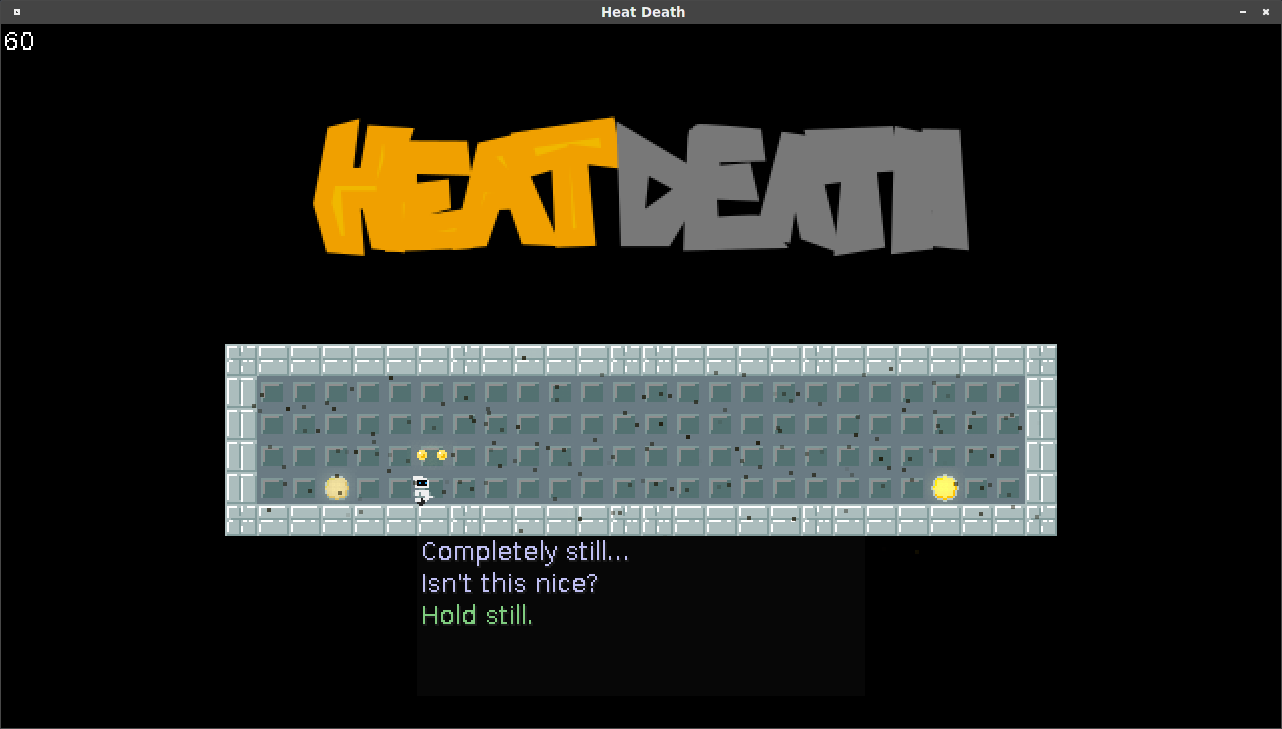
As a tiny robot, you are powered by a mysterious, unstable energy source. You can become more stable by double-jumping, dashing, and even ǵ̸̮l̸̖̓í̸̹ţ̵́c̴͍͝ḧ̵͔́ through walls! Pay close attention to your entropy meter though. Run out, and you'll be immobilized while your body recharges. Absorb too *much* entropy and destabilize into oblivion! Explore 23 reasonably action packed levels, with a dynamic soundtrack and a surprising amount of juicy, glitchy effects.
Controls (Keyboard):
- WASD or Arrows: Move
- Space: Jump
- Left Shift: Dash
- Restart: R
Development:
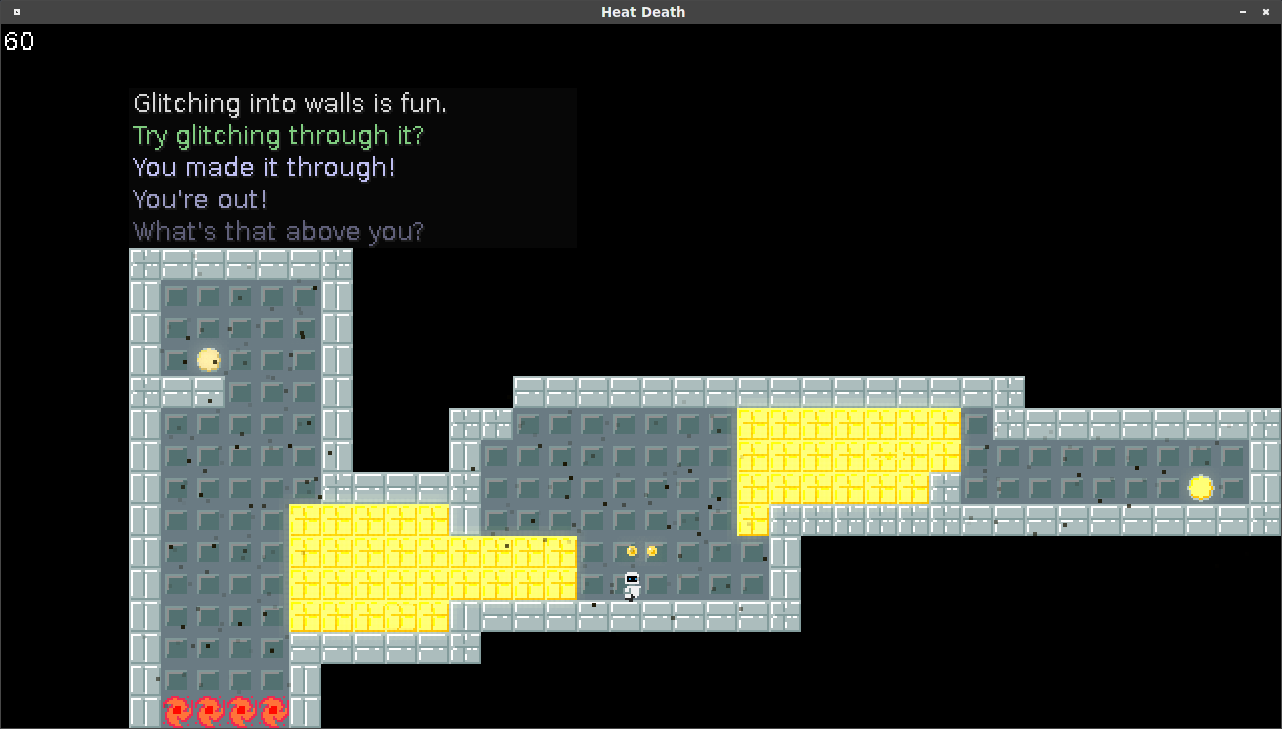
Written in TypeScript and compiled to Lua using TypeScriptToLua and type definitions from love-typescript-definitions, we targeted LÖVE 2D. This let us rapidly iterate on a basic tile-based platforming engine and a simple state machine for the player. We implemented most of the movement ideas we came up with, but ended up scrapping grand plans for additional entities and challenges. We succeeded in including a terminal-themed narrator to not just introduce the player to the game, but to have witty and reactive commentary on the whole experience. For the time constraints, with one of us learning the language for the first time over the weekend, and another of us using the LÖVE 2D engine for the first time, we’re pretty happy with how this turned out.
Also, the framerate may be a little unstable if you’re on weaker hardware. (That includes two of the developers by the way.)
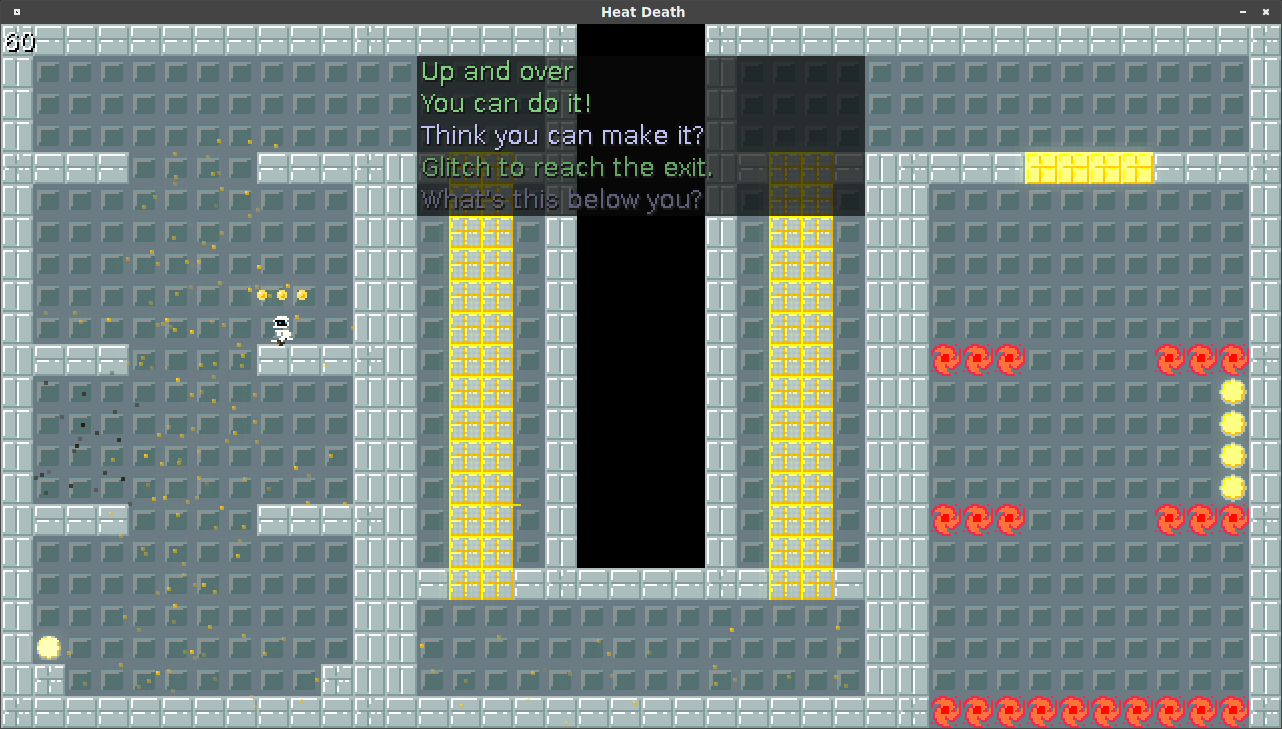
zeta0134 produced the music in Dn-FamiTracker, using the Namco 163 sound chip, for wavetable goodness. Sound effects were mostly produced via jsfxr, with a few odd public domain samples here and there. cromo provided background tiles, sprite art, and special visual effects (including the glitch and particle effects!), and Zach whipped up a flexible level loading system and a surprisingly capable story engine for the in-game terminal. Everyone pitched in with level designs, mechanical tweaks, and general coding bits. Good fun all around.
Comments16
In House Studio5 Oct 2021, 01:46
Had a blast! Played through all the levels. Wonderful variety in each level design, and great job teaching the controls throughout the game!! #Telesplat2000

OllieOA5 Oct 2021, 04:11
Very cute! Love the production. The lack of engine made this a very crisp experience. Very technically impressive!

EdevJogos5 Oct 2021, 04:27
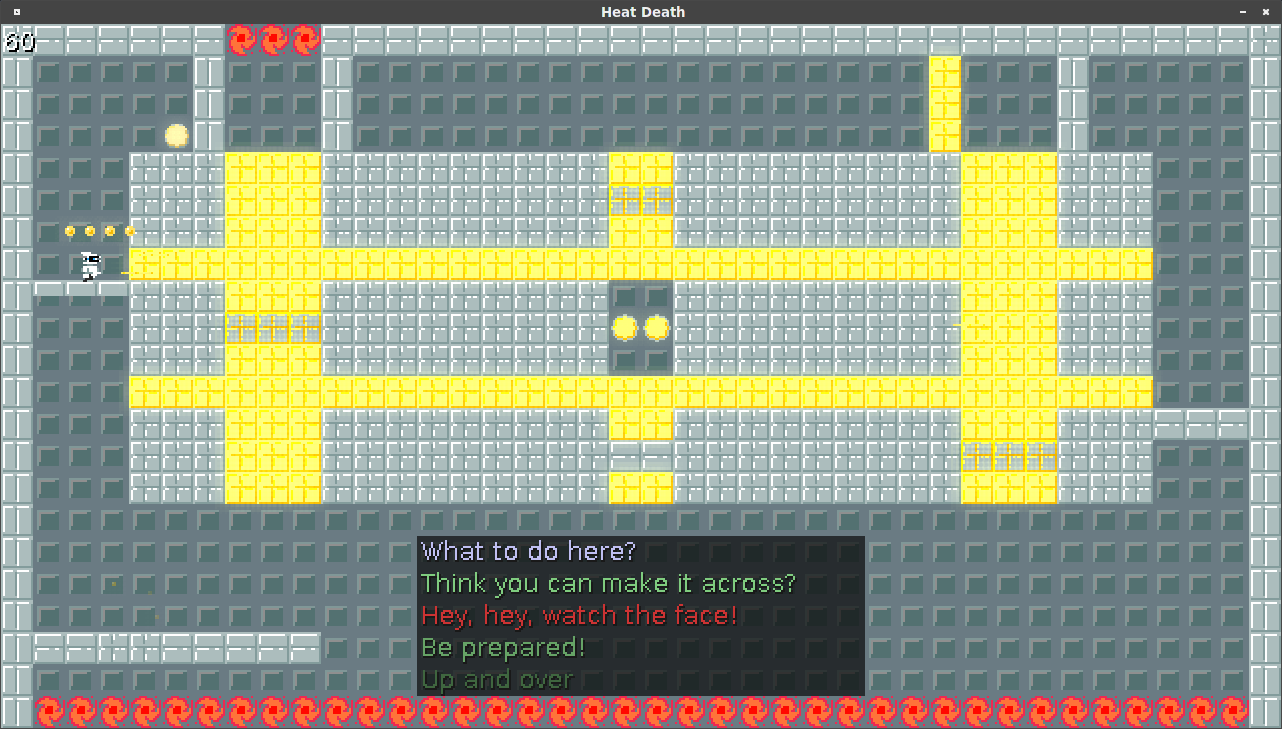
Really fun game, i've enjoyed a lot playing, the dialog is also super fun, and i belived you you said they looked friendly... XP Couldn't figure out how to get pass that level that has a huge yellow formation at the center, anywhere i dash i hit a solid wall or/and die.
cromo5 Oct 2021, 04:32
@edevjogos Thanks for the kind words! If it's the level I'm thinking of, you need to move diagonally through it, maybe after jumping in order to go all the way across the map.

ThatANoNoWord5 Oct 2021, 05:12
A great game! The movement and mechanics are polished to a shine. The platforming and semi-puzzle aspects are fun to go through! More mechanics and levels would boost this game much further. Great game!
marbles5 Oct 2021, 08:34
Cool game! I really enjoyed it! Sounds and music fit the game. The level design is very good. And the tutorial is well done and there were enough levels to explore and enjoy the mechanic. I finished all the way through.

Naymsayk5 Oct 2021, 15:00
I like the dialogue and the level design the mechanics worked super well but there is a certain amount of standing around and doing nothing while you are waiting for entropy builds. Apart from that I thought it was great.
cromo5 Oct 2021, 15:16
@naymsayk Yeah, the balancing around entropy growth wasn't quite where I would've liked it, but we were down to the wire with what we had - our last commit had less than a minute remaining on the clock! It's definitely something we would tune with a bit more time. Some levels were created before we even had the ability to spawn the player with different starting entropy, so that probably contributes to the slowness too. Glad you liked it!
Zachery Delafosse5 Oct 2021, 16:04
@naymsayk There was actually a proposed mechanic that didn't make it into the game, where if you glitched into a normal wall it would charge your entropy. So something as simple as glitching while holding down (so you would glitch towards the floor / not move at all) and there would be some particles and you would be net positive in entropy. It was proposed as a way to travel up walls or even across ceilings (glitch once into the wall and then once ahead indefinitely, if you could keep it timed), not as a way to fill the player's spare time, and so it didn't seem as necessary (the player is already quite mobile as it is.). In hindsight though it would be a fun thing the player could do anywhere that would directly solve their waiting problem. Whoops!

Togimaro5 Oct 2021, 16:43
The chiptune (especially when the music evolve) and the pixel art is great!!
The first double jump levels was quite hard to understand, it takes me a few level after it to understand how I've managed to clear it (by luck and retry) ahaha
Otherwise the rest of the game is very neat! There are some great level design, remind me of Celeste by moment!
Great job!
The first double jump levels was quite hard to understand, it takes me a few level after it to understand how I've managed to clear it (by luck and retry) ahaha
Otherwise the rest of the game is very neat! There are some great level design, remind me of Celeste by moment!
Great job!
Dante20015 Oct 2021, 23:58
terribly good! loved the music!! loved the controls, they were really tight! dialogue was a nice flavor! its perfect!
Copito6 Oct 2021, 00:42
This was really fun, I didn't have too much trouble completing it and I felt the pacing was quite good. I found the difficulty a little bit up and down, the middle levels seemed the most difficult with more resource management required compared to the last few levels I could just platform my way through, but I actually kind of liked that as it felt like a reward for learning the mechanics. I agree with the above comment that standing around waiting for entropy was a bit of a negative, but it was such a core mechanic any change to it would make the game feel totally different I think.
Tobold H6 Oct 2021, 00:43
The level design was awesome! It was a fun challenge to both plan and execute strategies. The entropy mechanics were great, especially in the later levels, and you nailed the brief!
cppchriscpp6 Oct 2021, 06:45
Wow, that was a fantastic entry! Easily one of my favorites I've played so far. I really liked the level designs, and you created a lot of content in the context of the jam. The levels were just the right level of challenging, and the mechanics were easy to pick up, and fair. The music effect you used was really cool too. I managed to beat it, but not without a good few deaths! If you wanted to, I bet you could expand on this quite a bit.
I really have nothing but positive things to say - thanks for a really fun game!
I really have nothing but positive things to say - thanks for a really fun game!

Locke86 Oct 2021, 15:59
Really nice one, i enjoed the way the controls were taught thorugh the level's design. The platforming felt fairly good, especially the dash, it gives a nice sense of "UMPH". The entropy can sometimes take a bit too long to recharge, which can slow down the game a bit. there isn't much to complain here, its a pretty solid game.

very fun and intuitive
love every level