On your last day at the world’s last pneumatic post office, you discover the tubes reach further than any map - across cities, across centuries.
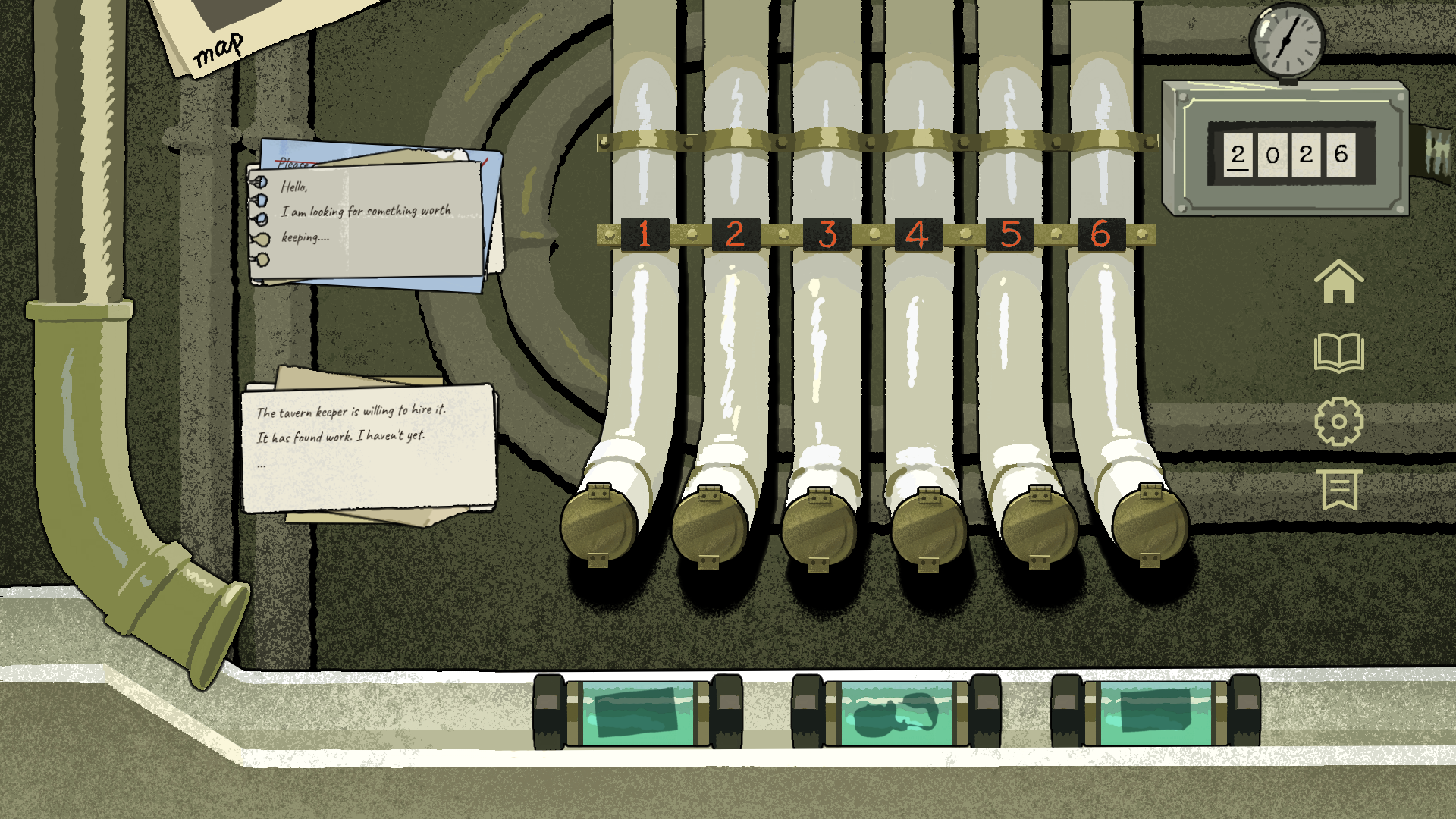
Match the objects on your desk to the letters in your hand, Send them off and see what comes back. But read carefully: the last owner’s description is all you have, and they didn’t always know what they were holding either.
How it works
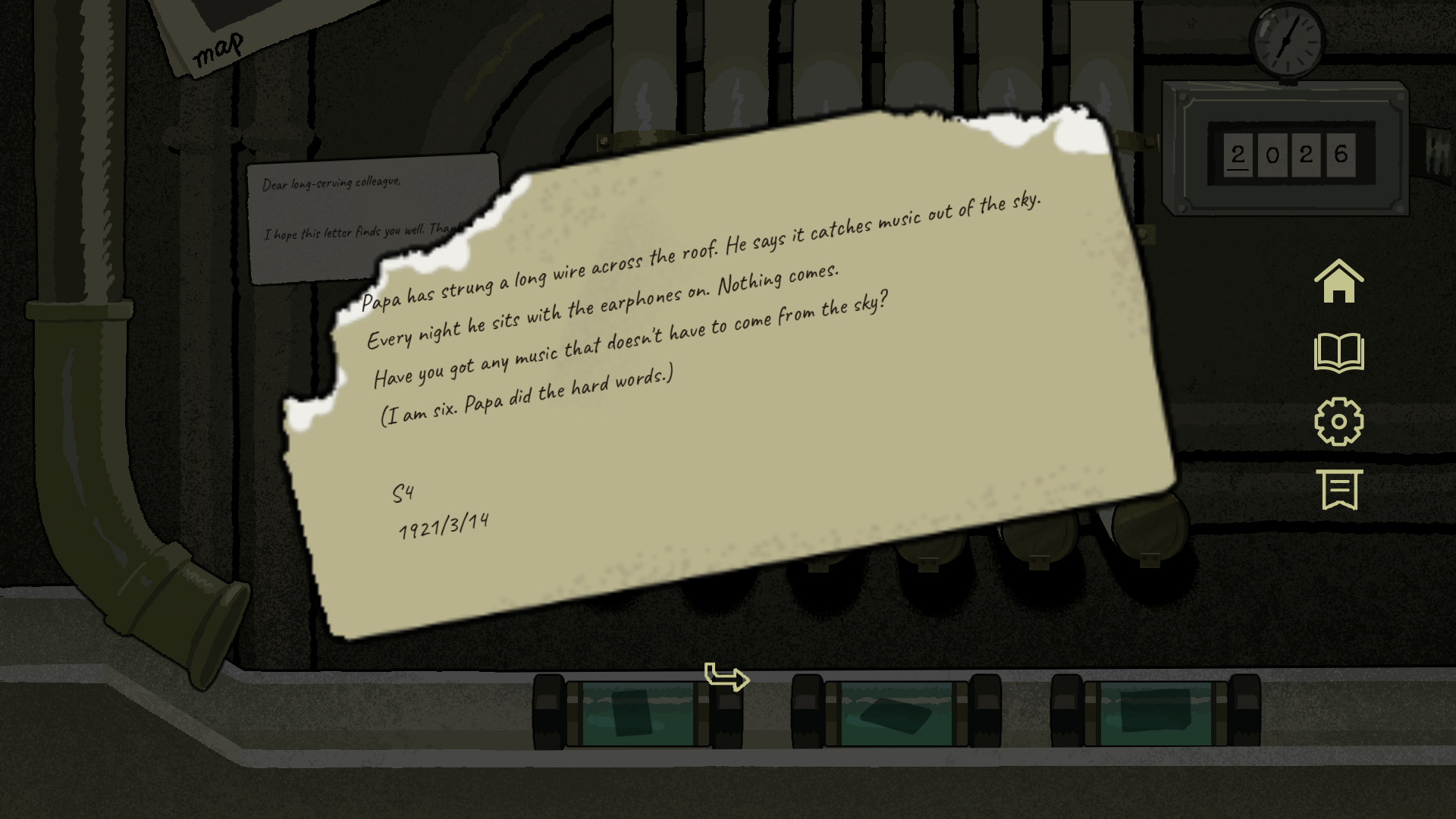
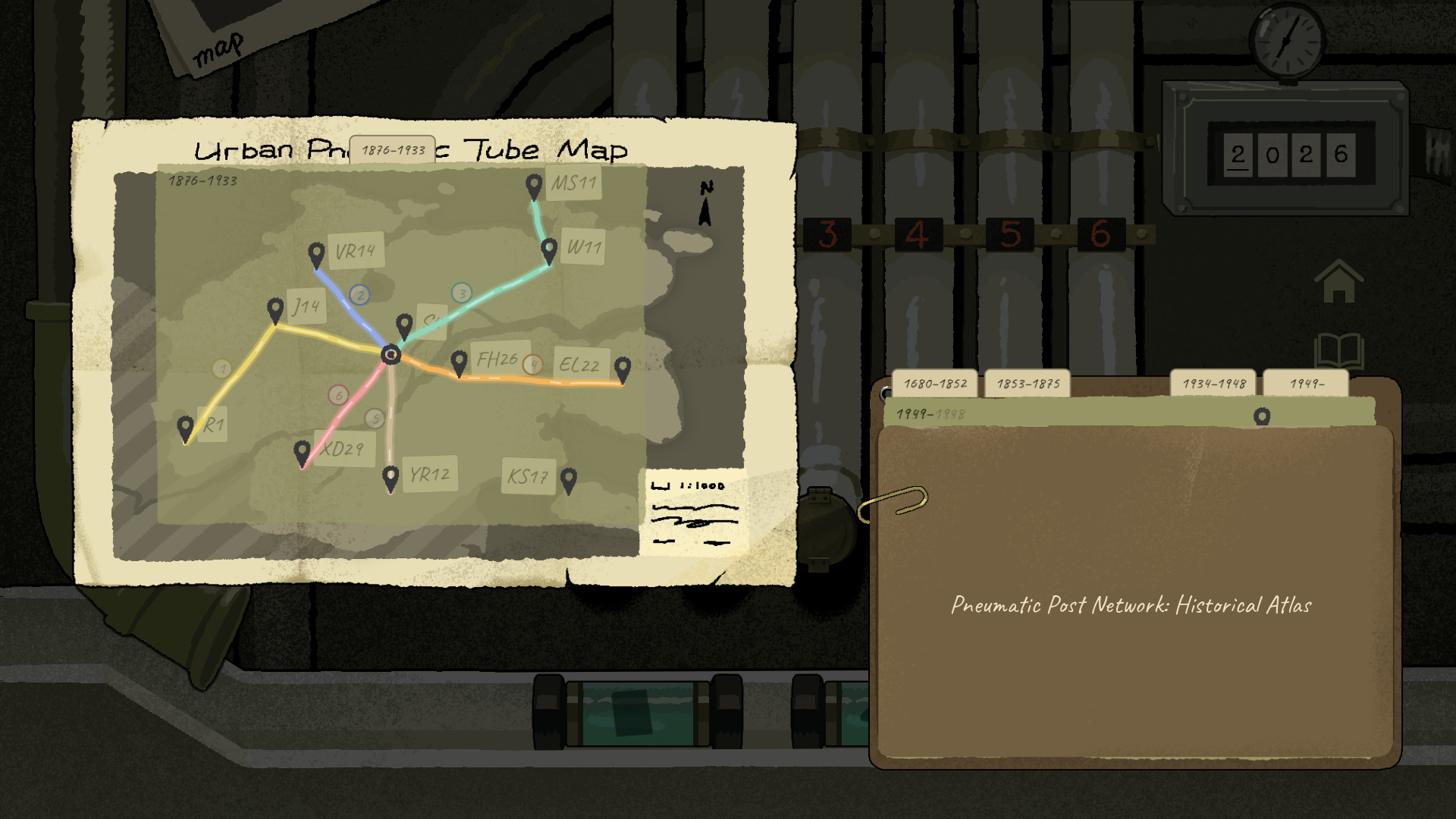
Read the letter, then work out what the objects on your desk actually are. Turn the dials to the right year, find the matching tube on the era map, and send. If the recipient is happy, they send back something from their own time. If not, your package comes back to you. There’s no money here. A player piano can buy you a toothbrush. Every object that gets accepted goes into your catalogue. There you’ll learn what it really was and every hand it passed through: who owned it, how they described it, and why someone finally took it.
- Controls: Mouse and keyboard - Language: English / 简体中文 - Length: About 15 minutes
Content note: The game mentions death, historical medical practices and radiation, and briefly touches on mature themes.
Credits
- Design: draccoon, space_yoga, Spring - Programming: draccoon - Art: Spring - Writing: space_yoga, draccoon - Music: The Tourist - Sound effects: https://www.ear0.com, selected and downloaded by The Tourist - Fonts: Caveat, Inter, EB Garamond, Nunito, Noto Sans SC, Noto Serif SC, Ma Shan Zheng, and Yozai by lxgw, all under SIL OFL 1.1 - Reference images of historical objects were collected from the internet. Full sources are listed in the in-game credits. - Made with Godot.
No AI was used to create the game’s artwork or music, or to write the Chinese-language text, except for some in-game orders and letters. AI was used to assist with game programming, translating some text into English, and suggesting improvements to phrasing, as none of the team members are native English speakers.
Solid mood, satisfying steam sounds sending tubes through time! I liked the touch of the letters having flair from their era, and appreciate all the work that went into the writing, some great return letters when you sent packaged to the wrong year. Great vibe!
Love the atmosphere and gameplay. Just needs a bit more of an overall goal, really, and you've got a gem in your hands. I'd also recommend a way to get rid of some of the messages you get, since they seem to stack up infinitely & could definitely begin to cause lag after some time.
Interesting game! I liked the concept, thought it was fun to match stories to items. The transparency on the map to signify different lines was neat. I did feel the game went on a bit long, but I stuck it through to the end and chose the ending where I went inside. Art and music were very good. Overall, great job!
WOW, lots of fun. Theme is perfectly displayed though rather ironic that it is powered by a time machine which would be future tech. Never the less, full points for old tech! I actually spent a good 35 minutes playing before the game crashed on web, might have been something on my side. Lots of nice touches that are subtle details like the paper types and the language from their era.
I highly recommend expanding and making a full game out of this. It has all the ingredients that keeps you engaged. Little bits of each story is surprisingly interesting despite a short note.
@delta I’ll check for any issues that might cause the game to crash, as one of my teammates ran into something similar during testing. I’ll also defo give some thought to develop it into a more complete game :) thanks so much for spending so much time playing our game and for the nice words!
Wow. The game was amazing. The art, vibes, and sound design were all amazing. The art especially I loved the style. It felt like working an actual job (but in a good way). I have genuinely no complaints about the game.
@blake-mullin thank you for being the first person to leave a comment here and for mentioning those lil details! all those late nights over the past few days were worth it haha XD
The artwork is lovely! All the pipes, paper notes and little capsules give the desk so much character. Trading objects across different centuries is a really fun idea too, especially swapping a player piano for a toothbrush :D
Great job on this project! The visual style and audio fit together really nicely, creating an awesome vibe. Super impressive execution within the 72-hour limit! Left my ratings! If you have some spare time, feel free to drop by our page and try out our entry as well. Would love to hear your feedback!
Such a creative take on the Old Tech theme! I love the idea of trading objects across different centuries, and the catalogue adds a really nice storytelling touch. Super charming concept!
I really enjoyed this game, the letters were compelling and figuring out which item to send to fulfill a request was a fun puzzle. The music provided a nice relaxed atmosphere and everything was very cohesive. Great work!
I really like how the game looks and sounds. The little bits of story are interesting to read and the items in the capsules are often surprising and unexpected.
Somehow I managed to lose one of my maps halfway through the game. I dragged it outside of the screen accidentally. 😁
The game gets a little bit repetitive after a while. I think you could have introduced new game mechanics after every few packages to make the game less predictable.
@woona oh my, maybe that map accidentally fell into a pile of items and got shipped out with the rest XD
And thanks for the suggestions! I’m also trying to come up some new mechanics to make it more interesting. I’d love to hear any ideas from anyone reading this in the comments as well haha, thanks in advance! :)
@nursultan wasn’t even going to reply at first, but I think you should know that using AI to mass-generate comments on other people’s games to promote your own is inappropriate. I keep seeing your comments like this _everywhere_ 😅
The idea of piecing together the secrets behind objects and letters spanning different centuries is genuinely fascinating. It creates such a rewarding sense of discovery, making the entire process feel like an archive investigation. Great work bringing such a unique historical mystery to life!
the pneumatic post office is such a wonderful setting, and trading objects and letters with people from other centuries through a strange machine is a great hook. i love that the letters have flair from their era, it makes the whole catalogue feel like a little museum. was the time travel logic planned out first, or did the objects come first and the story grew around them? really lovely atmosphere.
I really liked this! I considered pneumatic tubes during brainstorming as well. The premise lends itself well to some interesting little vignettes, and I learned about a few new things (I like the abacus ring!). The ending was great as well. Very solid all around.
@perrarancino The objects came first, and the story grew around them.
When we were given the theme Old Tech, we thought of the book *Extinct: A Compendium of Obsolete Objects*, especially its mention of the pneumatic postal system.
It made us think about the value of old tech. Some techs have survived as the foundations of things we still use today. Others have become symbols of nostalgia, or are remembered for their distinctive aesthetic qualities(when someone mentions "old tech" certain objects and a particular atmosphere naturally come to mind.)
Yet countless other techs have disappeared into the passage of time, fading from both everyday life and collective memory.
If we set aside the Whig view of history—the idea that history is a steady march toward progress—and even put nostalgia aside, we may find that technological development is not a linear process. People and techs have always shaped and selected one another.
People in the past imagined many different versions of the present we live in today. Perhaps, by looking at some of these forgotten techs, we might discover that our world could have turned out differently.
Borrowing the form of the pneumatic postal system, we wanted to create a barter-based exchange system. Rather than measuring objects by their monetary worth, technological sophistication, or aesthetic appeal, we wanted every object to stand on equal footing.
And since these objects belong to different times and places, exchanging them naturally becomes a journey through time.
Really loving this game! The color palette, cozy and atmospheric vibe and pneumatic tube mechanics are fantastic. The deduction and map-based routing gameplay strongly remind me of Strange Horticulture.
Comments29
The mailman swore all the way up the stairs.
I highly recommend expanding and making a full game out of this. It has all the ingredients that keeps you engaged. Little bits of each story is surprisingly interesting despite a short note.
Great work!
The art, vibes, and sound design were all amazing. The art especially I loved the style. It felt like working an actual job (but in a good way). I have genuinely no complaints about the game.
Left my ratings! If you have some spare time, feel free to drop by our page and try out our entry as well. Would love to hear your feedback!
Somehow I managed to lose one of my maps halfway through the game. I dragged it outside of the screen accidentally. 😁
The game gets a little bit repetitive after a while. I think you could have introduced new game mechanics after every few packages to make the game less predictable.
And thanks for the suggestions! I’m also trying to come up some new mechanics to make it more interesting. I’d love to hear any ideas from anyone reading this in the comments as well haha, thanks in advance! :)
When we were given the theme Old Tech, we thought of the book *Extinct: A Compendium of Obsolete Objects*, especially its mention of the pneumatic postal system.
It made us think about the value of old tech. Some techs have survived as the foundations of things we still use today. Others have become symbols of nostalgia, or are remembered for their distinctive aesthetic qualities(when someone mentions "old tech" certain objects and a particular atmosphere naturally come to mind.)
Yet countless other techs have disappeared into the passage of time, fading from both everyday life and collective memory.
If we set aside the Whig view of history—the idea that history is a steady march toward progress—and even put nostalgia aside, we may find that technological development is not a linear process. People and techs have always shaped and selected one another.
People in the past imagined many different versions of the present we live in today. Perhaps, by looking at some of these forgotten techs, we might discover that our world could have turned out differently.
Borrowing the form of the pneumatic postal system, we wanted to create a barter-based exchange system. Rather than measuring objects by their monetary worth, technological sophistication, or aesthetic appeal, we wanted every object to stand on equal footing.
And since these objects belong to different times and places, exchanging them naturally becomes a journey through time.