Really nice! The mechanic flows naturally from the elements involved, and ends up being challenging but relaxing, very in the spirit of the theme. BTW -- I fixed the Linux build of my game if you want to try it. :)
Beautiful game! I like how its tranquility encourages the player to sit back and think about a path before drawing it. At least that's what I experienced.
As others have said, it would be great on a tablet or something. You should definitely continue to develop this prototype into a bigger game. Think about how the gameplay could be expanded a bit.
Really well polished graphics, love the effect of the lines on the sand.
Awesome job!
M
Monxcleyr Productions5 May 2013, 03:14
Beautiful, relaxing game. The difficulty curve was manageable but challenging. Some of the best art I've seen thus far, and the music fit the mood perfectly.
Great progression! Without a tutorial, the design communicates the techniques to move the rake most efficiently but leaves room for players to experiment on their own.
Although, the collision box frustrated me sometimes as I wasn't sure if I collided or not. Also, I was stuck for countless movements sometimes when some unfortunate collisions occured, so I think the scoring system isn't really fit.
Very impressive! Fits perfectly with the theme both in terms of mechanics and presentation. The sand effect is extremely satisfying. How did you achieve that?
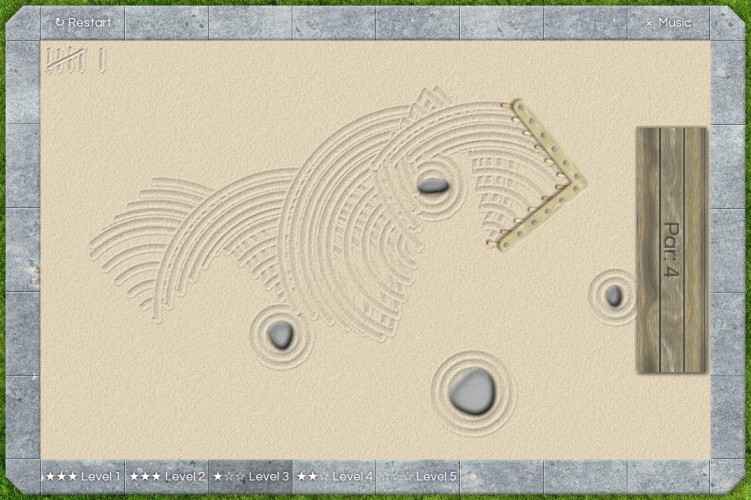
The sand is basically a bump map, done in software JavaScript (CoffeScript). A height map indicates the level of the sand at that point, 0-255 with 128 being the initial value. We can easily draw arbitrary things into the height map, because it's just a regular (albeit invisible) canvas element.
To show the rake's trail, we draw a series of "dent" sprites, which are small circles that are black in the centre (the trough), white around the outside (the little wall around the trough, where the sand was pushed out), and then fade out to transparency (so the wall slopes gently outwards). To prevent dents overwriting each other, each dent is actually a semicircle, rotated so the round side faces the direction of movement of the rake.
We then calculate the lightness of a pixel based on the dot product of the normal with the light vector, as in regular Phong shading.
To this we add some random noise based on the normal and the pixel's location, which means that every small change in the height map results in some noisy change to the colour. This gives the impression of grains of sand rolling around.
All this would have been much easier and faster in GLSL shaders, but as we started out with 2d canvas, it had to be all software rendering. Which, in spite of several optimizations, is why it's still a bit slow on Firefox.


Comments41
As others have said, it would be great on a tablet or something. You should definitely continue to develop this prototype into a bigger game. Think about how the gameplay could be expanded a bit.
Very well done!
I updated my project page with a hint for RED. Cheers.
Awesome job!
Really well polished graphics, love the effect of the lines on the sand.
Awesome job!
All I wanted was a "undo" button, that allowed me to cancel my last move.
Also a "sandbox" (heh) mode, where I can place stones at will and play with the rack would be welcome :-D
Thanks for the game!
- SEPHY (@sephyka)
Although, the collision box frustrated me sometimes as I wasn't sure if I collided or not. Also, I was stuck for countless movements sometimes when some unfortunate collisions occured, so I think the scoring system isn't really fit.
Polish thingies tho. :)
This belongs on mobile/tablets!
The sand is basically a bump map, done in software JavaScript (CoffeScript). A height map indicates the level of the sand at that point, 0-255 with 128 being the initial value. We can easily draw arbitrary things into the height map, because it's just a regular (albeit invisible) canvas element.
To show the rake's trail, we draw a series of "dent" sprites, which are small circles that are black in the centre (the trough), white around the outside (the little wall around the trough, where the sand was pushed out), and then fade out to transparency (so the wall slopes gently outwards). To prevent dents overwriting each other, each dent is actually a semicircle, rotated so the round side faces the direction of movement of the rake.
We then calculate the lightness of a pixel based on the dot product of the normal with the light vector, as in regular Phong shading.
To this we add some random noise based on the normal and the pixel's location, which means that every small change in the height map results in some noisy change to the colour. This gives the impression of grains of sand rolling around.
All this would have been much easier and faster in GLSL shaders, but as we started out with 2d canvas, it had to be all software rendering. Which, in spite of several optimizations, is why it's still a bit slow on Firefox.
I'm no stranger to needless software rendering: http://namuol.github.io/earf-html5/
;)