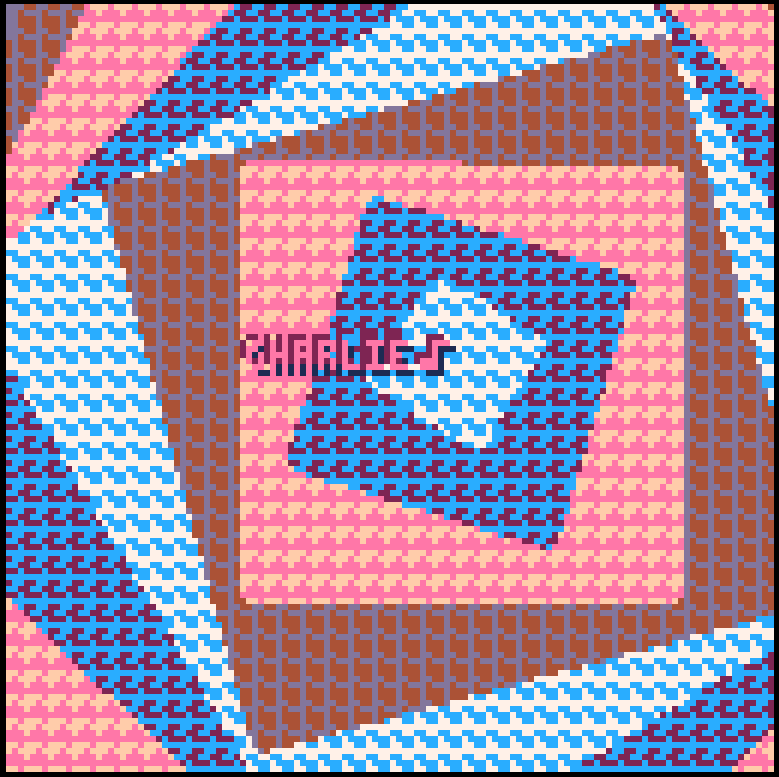
Charlie is teaching his music brain to compose sequences. Move him around with the arrow keys and interact with Z and X.
When he starts the machine for the first time, it will make a random sound or maybe nothing at all. To hear the sound of this brain again he can press the green PLAY button in the upper left. To reward the machine for playing something sort of musical, he can press the red LEARN button. This will modify the brain and a new sound will play, usually similar to the first but not always. If the new sound is still "musical," he can press LEARN again to get more creative. To save this brain to the cartdata, he can press the gray SAVE button. To randomly reset the brain's concept of music, he can press the blue RESET button.
Charlie has come to understand the relationship between time and music and has decided to control the sound's speed and length directly. He can do this by changing the HEART (low for fast) and HOURGLASS (low for short) values in the upper right. The SPIRAL value is a chaos control that affects the randomness of the brain's impulses.
If the brain is not making musical sounds, he can modify any node directly by moving on top of it, pushing the value up or down with the buttons. If he presses both buttons on a node, it will change randomly. The weights of the nodes and edges are represented by color patterns. The first column of nodes are input nodes associated with instruments, pitches, envelopes, and volumes respectively. Modify them and press play to get a new sound from the machine using the current brain, without changing any connections. The middle columns are learning nodes. Modify them and press learn for chaotic, unpredictable behavior. The right column are output nodes mirroring the input nodes. Modify these and press learn to train the brain to produce those outputs when given the current inputs. (left column)
The brain is answering a simple question, "what note should come next?" The input (left) being the 'current' note and the output (right) being the next note. When Charlie presses play, the brain answers that question for what is currently on the left, producing an output. It takes that output, and puts it back in as input, and repeats to generate a sequence of notes. The sequence of notes that it has generated are visualized at the bottom of the screen and highlighted as they are played. If Charlie moves on top of it he can access a control to add and remove sequences.
Good luck have fun! The genres could be puzzle and rhythm.
Biggest complaint - it was so hard to see Charlie :(
The concept of the game is awesome - I'm a sucker for music building games. You were able to accomplish a lot with 48 hours, and I could spend some serious time going through it. Super impressed I loved all your write up too! It made me connect just a little deeper and think about it as a little world, instead of just a music creation game.
Intriguing concept. I only wish the controls were somehow more responsive so you could get a sense of what you are doing to the system. For a while I thought mouse input wasn't working, but it was.
I have to agree on previous reponses. There are too many things happening on screen and I still don't really know how it works/what is the goal. I searched ages trying to find a key that does sth (Z). Some guide would be nice :/
Thank you all for the kind words! The goal of the game is up to you. Figuring out how to get past the noise into more musical things is part of the puzzle/experience. I want to let you know that I’m going to keep working on this. It was my first jam, so sorry for the usability issues, they are my next priority. I will add options to turn off the background, mouse input and also a better mobile version. The controls are just standard pico-8 controls, I didnt think to expand on them! Also yes it is a feed forward neural network although very small.
Super weird but in a good way. Had fun toying around with it for a bit. You could definitely do something interesting with these wild soundscapes that Charlie builds.
Thanks for this interesting little tool! It's one of the most creative projects I've encountered so far! I didn't really figure out how to use it properly, but experimenting with the various options and watching the background shift was still thoroughly enjoyable anyway!
This game is what I imagine being on acid is like. Utterly bizarre, but brilliantly unique, and quite the accomplishment in PICO-8. I look forward to seeing how this develops!
Interesting idea, although the output is hard to discern and tell how to really control what I assume is a neural network. I couldn't figure out how to get it to play a longer loop as well, each iteration played the same loop time
It seems like the player is adapting a neural network which is a really cool concept for a game. I couldn't produce nice sounding music yet but it lead to really fun puzzle gameplay! I'll be re-visiting this later.
This is a really interesting game. I love the concept of it and that it's actually my creativity that is in focus. Well done! I hope you keep working on this one.
As promised I've added options to turn off background (or turn off UI :) also you can enable Mouse controls (a little buggy). All done through the pause menu which is RETURN key or move charlie to the upper right pause symbol and press Z. (speed/length controls now underneath the sequence) Also some slightly different mechanics. It might feel a little different
I'm not a musician but experience like this was always fun for me. You know randomly playing with synths or crazy instruments. Teenage engineering vibe here :)
The backs and graphics are cool and doing the job.
I did succeed with making some "music" but anyways I'd like this to be a bit less confusing. The "neural music engine" itself is worth exploring and playing around, but it lacks feedback loops and overall UX to see how you can affect it. It doesn't mean less crazy or random stuff but a bit more clarity so players could reveal full potential of Charlie :)
I'd like to see more experimental stuff like this on gamejams. Highest rates from me and best wishes!
This is certainly one of the more interesting, experimental, and adventurous game jam projects I've seen to date: a neural network music creation tool. The visualization was certainly very beautiful to say the least.
That said, I had absolutely no idea what to do or how to do it. Like, at all. I could change the node values, but I didn't know what effect it was having on the music, or even how to tell which node I should even be rewarding. I wanted to teach a machine how to make music, I really did. But I was completely and utterly in the dark the whole time and I think the experience was completely ruined for me because of it.
Very interesting and experimental! Kudos for that. Unfortunately I had a hard time figuring out how to work it and felt a little overwhelmed by the visuals. Still, unique and creative idea.



The concept of the game is awesome - I'm a sucker for music building games. You were able to accomplish a lot with 48 hours, and I could spend some serious time going through it. Super impressed I loved all your write up too! It made me connect just a little deeper and think about it as a little world, instead of just a music creation game.
10/10 would make crap music again.