Ludum Dare #45compo
Conjury: The Convocation the RPG
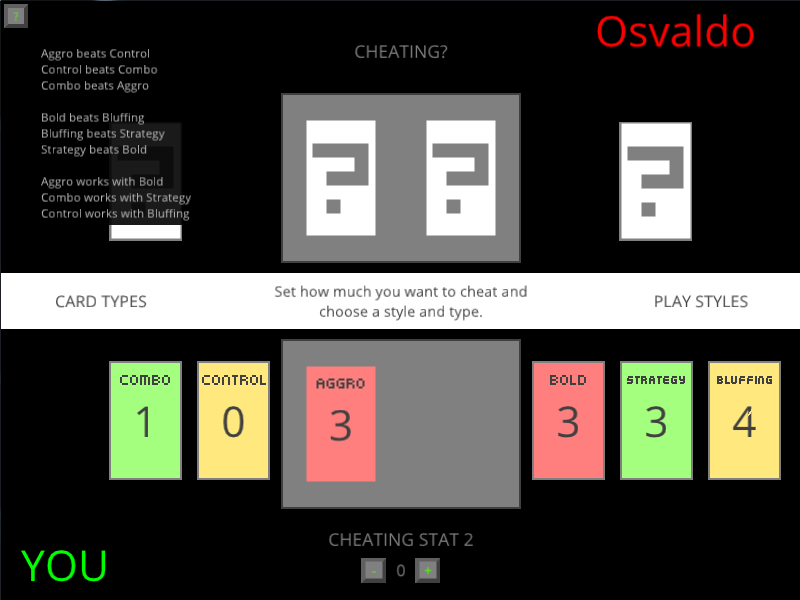
The game consists of three primary screens:
Character - Where you can allocate points for your character, your card collection, and your deck. There are descriptions of what each skill and card type does. It's important to make your deck, it is what will be used during a match.
Hub - Where you choose what tournaments to play, trade for new cards, and access the character screen. You should try to trade after each tournament. After each tournament there is also a chance you'll get a skill point to spend.
Match - Playing a match against an opponent.
How to play a match:
Matches are divided into four phases
1. Initial Choice - During this stage you choose the Card Type you'll be focusing on and your Play Sytle. The value of each Card Type is taken from your deck. The value of each Play Style is equal to the number of points you put in that skill. Click on the cards to side to choose it, click on the ones in the center to unchoose them. You can also adjust how much you want to Cheat by using the two buttons at the bottom.
2. Observation - You and your opponent now do a an opposed roll against each of your Observation skills. There are three possiblities:
i. You win: You get a chance to reveal either the opponents Play Style, Card Type, or their Cheating value. After you've revealed something you can make adjustments to your Play Style, Card Type, and Cheating.
ii. Opponent wins: You don't get to do anything. Your opponent will reveal something and make adjustments.
iii. Tie: Both you and your opponent can make adjustments. The adjustments are applied after you reveal something.
3. Resolution - You and your opponent make an opposed roll. The base number of dice rolled is the sum of the values of Play Style, Card Type, and Cheat. These are rolled against a base Target of 4. Any die rolled above or equal to the Target counts as a success. The person with the most successes win. Ties are rerolled. There are also various modifiers applied before the rolls are made.
i. If a players Card Type has advantage against the opponents Card Type the Target of the advantaged player's roll is reduced by one.
ii. If the players Play Style has advantage against the opponents Play Style the Target of the advantaged player's roll is reduced by one.
iii. If the players Card Type and Play Style work well together the number of dice rolled is increased by one.
iv. If the player is using a net deck they Target of their roll is increased by one.
4. Cheat Detection - Finally the winner makes an opposed roll of their Cheating stat versus how much they Cheated in the match. If the Cheated roll is greater they were caught, and they lose.
Card Type Advantages:
Aggro beats Control
Control beats Combo
Combo beats Aggro
Play Style Advantages:
Bold beats Bluffing
Bluffing beats Strategy
Strategy beats Bold
Type-Style Synergies:
Bold words with Aggro
Bluffing works with Control
Strategy works with Combo


Comments10
Also, it doesn't really seem to fit the theme. You start with nothing but a bunch of points, sure, but those points let you build a reasonable deck at the very beginning so I don't think it works.
I liked trying to strategise, though it was a bit complicated keeping track of the rock-paper-scissors relationships. It does seem like the better approach is to put all your points into one deck style and simply have more dice; you get 2-3x as many dice to start with that way, so a +1 or -1 doesn't change much.
Sadly I kept hitting a bug where the game would get stuck on "rolling observation" over and over and I had to quit.
Since the rewards were the same (just less often) for the bigger tournament, there didn't seem to be much reason to play anything other than easy local tournaments to build up stat points. I ended up winning the game without cheating (other than once to try it out...) with a Combo:5/Strategy:7 deck. For a while I wasted putting points into "observation" because I thought more information would make things more interesting, but in the end just putting all of my points into one card+strategy type seemed to be the best tactic, which wasn't super interesting. I think if I had put my starting 13 (15?) character points all into Strategy (or whatever matched an available 'net deck') it would have gone much quicker =).
Nice job on the game! That's a lot of content and systems to get done, and they all worked pretty well, and was interesting!
That said, I'm _really_ confused by @geoff-nagy's comment - as far as I can tell this game has no audio, right?
Always match your strategy to your deck. The target number reduction overwhelms everything else at high levels.
I beat Masters with 8 Strategy, 8 Bold, 5 Combo, 5 Aggro, 10 deckbuilding, 10 trading, and 8 observation. Was a lot of fun. Spent too long on it. >.>
@philomory : There's background music when you start the game (at least in the windows version).
A quick bug report: couldn't play the game on the website, I'm getting the following error:
```Error in initRendering while creating context: Could not create EGL context (call to eglCreateContext failed, reporting an error of EGL_BAD_MATCH)
13```
Could possibly be my computer though, as it does struggle with other web games (old Nvidia card...). Even so, maybe it's useful for you.
Good job!