A one player version of John Conway's zero player "game of life". NOTE: The browser version is somewhat playable, but NOT recommended, as it runs poorly, I removed the music, and some features do not work.
As Conway recently passed away from COVID-19, this game serves as a tribute to his life and his work in mathematics.
From Wikipedia: The universe of the Game of Life is a two-dimensional orthogonal grid of square cells, each of which is in one of two possible states, alive or dead, (or populated and unpopulated, respectively). Every cell interacts with its eight neighbours, which are the cells that are horizontally, vertically, or diagonally adjacent. At each step in time, the following transitions occur:
Any live cell with fewer than two live neighbours dies, as if by underpopulation.
Any live cell with two or three live neighbours lives on to the next generation.
Any live cell with more than three live neighbours dies, as if by overpopulation.
Any dead cell with exactly three live neighbours becomes a live cell, as if by reproduction.
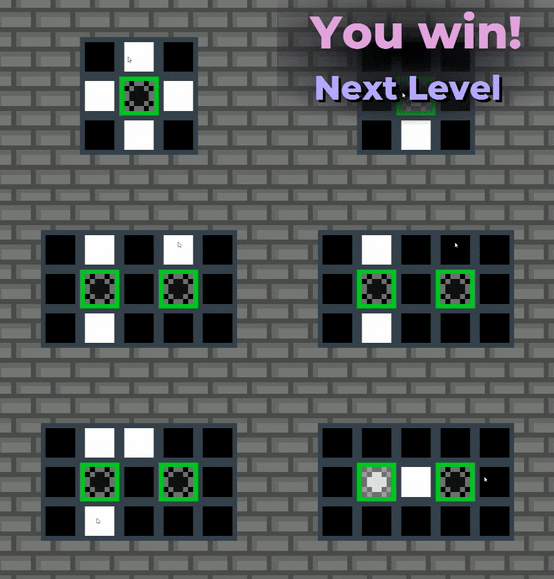
@chloeofarroyo It's a flaw in my level desgin that it seems that way, but it's actually just that the configuration in the second level is stable, even if you add a cell. The solution is therefore to remove a cell.
Ahhhhhh right that makes sense! making good progress right now, tis a fun game - might want to make clear to players though that space can be pressed multiple times (As I assumed it was 'solve in one move') :)
Great sound and presentation! The interactions between cells was difficult to grasp at first, but after lots of trial and error, started to make sense. More user feedback and general hand holding early on would be welcome. That being said, I was engaged enough to stick around until it made sense. Very nice puzzle game!
I thought of making a game in memory of Conway but I failed to find a good way of adding interaction into the game of life. Your idea of manually controlling time steps and changing some cells at any step is awesome!
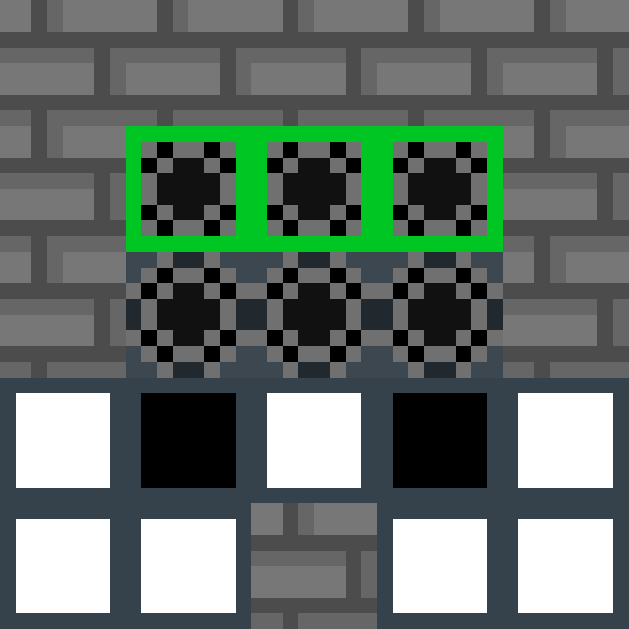
I really love the concept, the game works great, but it is sooo difficult at times and sooo easy at other times. This is definitely my favourite approach to conway's game of life, for sure. Some things, Z to undo is pretty universal by now, so having the U to undo was awkward, the game didn't presented well the idea of being able to use moves after start pressing space, the glider level was definitely my favorite. I'm stuck in the 4x4 green square. I'm not sure if levels could be any different, but I guess it can be even more difficult to design levels for this. Congratulation, I really liked your entry!
@le-slo Thanks for the feedback! I absolutely agree that the weakest part of this game is the level design. Unfortunately I didn't have much time to work on that aspect, which made the difficulty curve terrible. I'll be sure to change undo to Z if I make a post-jam polished version. I'll also try to see if I can make a much simpler introduction to the idea of altering the game state after the first iteration.
Very well made. Some of the levels were pretty hard, I enjoyed solving them. I particularly liked the glider level. The animations for cells being born/dying were a very nice touch.
I'm using Linux, but got ``` Error: Couldn't load project data at path ".". Is the .pck file missing? If you've renamed the executable, the associated .pck file should also be renamed to match the executable's name (without the extension). ``` (repeated twice). It worked when I downloaded the source and ran the executable from inside the source folder.


Comments19
And I've very seldom seen the simulation turned into a real game.
This works.
Some levels were too hard for me so I've had to spend a bit more time, but a really nice concept.
Well done!
Keep up the good work.
I'm using Linux, but got
```
Error: Couldn't load project data at path ".". Is the .pck file missing?
If you've renamed the executable, the associated .pck file should also be renamed to match the executable's name (without the extension).
```
(repeated twice). It worked when I downloaded the source and ran the executable from inside the source folder.
The music is cool, and the animations are cool.
Some level are too difficult, but solving them is really enjoyable.